I Tested 20 Category Queries and Why 85 Percent of Polish Companies Don't Exist in AI
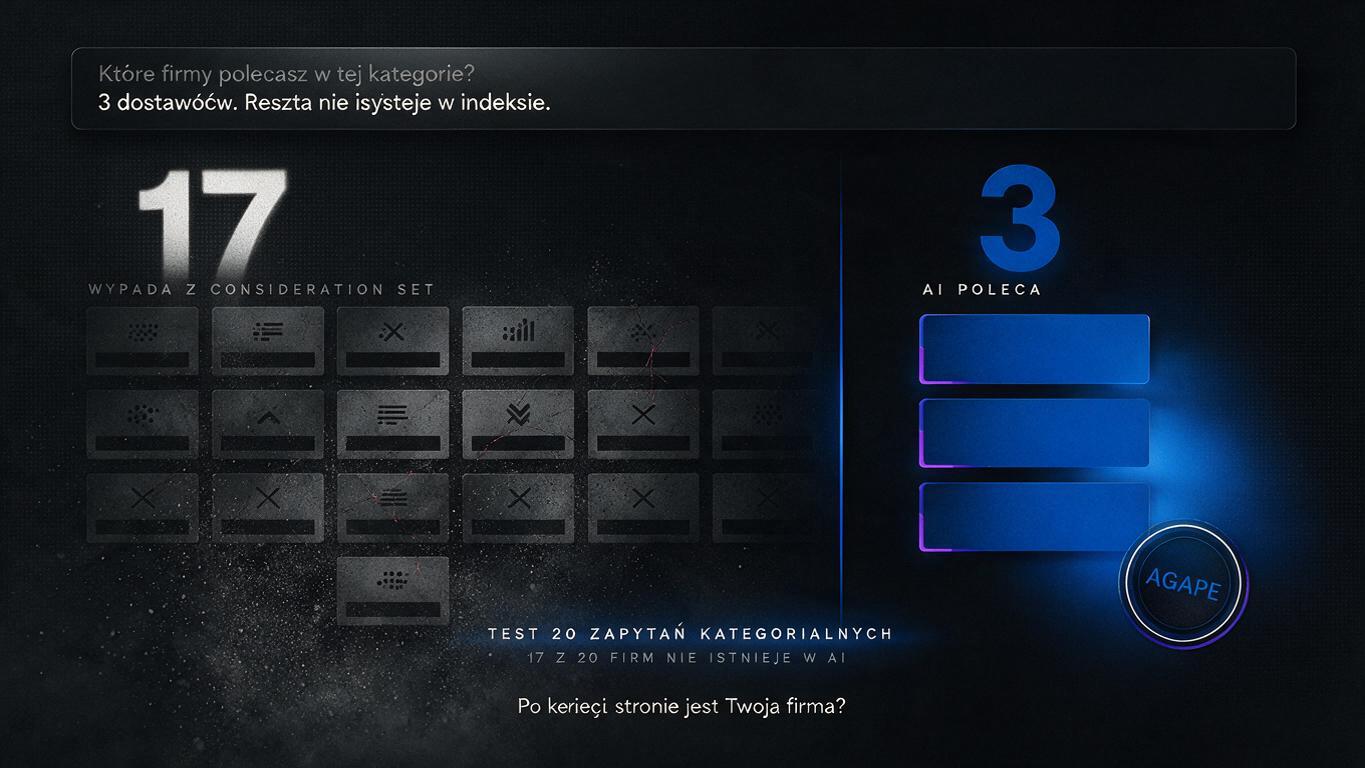
Twenty category queries were enough to see how many companies simply don't exist in AI answers.
In August 2026 I ran 20 category queries through ChatGPT, Perplexity, and Google AI Overviews. The result: 85 percent of the checked Polish companies never appeared once in any answer, and the same pattern is independently confirmed by research from other markets. The absence of a brand in an LLM is no longer a technological curiosity - it becomes a line item in the cost ledger that a CMO will see in the quarterly report.
What the 20-query test showed
I chose the questions based on real purchase intents that Polish tech companies raise in sales conversations. The spreadsheet included, among others, "best Polish B2B CRM for software houses", "marketing automation platforms for SaaS in Poland", "cold mailing systems compliant with PKE", and "AEO tools for B2B companies". Each query went to ChatGPT, Perplexity, and Google AI Overviews, and I logged brand presence together with the names of competitors that appeared in the answer - I recommend the same log format to anyone running an AI query test on their own.
The response pattern was consistent regardless of category. Assistants returned foreign brands, enterprise solutions from global directories, or skipped the Polish market entirely. In the CRM-for-software-houses category, ChatGPT pointed to products known from English-language databases and directory listings, while Polish tools with a strong position in classic Google never appeared once. In the SaaS marketing automation category, the answer was built on foreign rankings that Polish brands never made it into. In several categories, Perplexity returned results from comparison databases that don't include a single Polish vendor, and in two cases Google AI Overviews generated a summary without citing any local source at all.
Before the test I assumed Polish companies would perform poorly, but the scale only surprised me once I counted. 17 out of 20 queries didn't include a single tracked brand. The remaining three returned single names, mostly those with the highest recognition in classic search. I've scheduled a retest for 09/30, two days after this publication, and I'll compare the result with the August measurement.
The result in short: 85 percent of companies don't exist in AI when a customer asks an assistant about a category. This test is my own measurement, so I treat it as a starting point for a method any CMO can repeat themselves - 20 fixed queries, three assistants, a log of brand and competitor presence per answer. This is exactly what a B2B visibility test looks like once it stops being a one-off audit and enters the calendar like any other measurement.
Why the 85 percent result is backed by data
An extreme result from a single test needs a reference point, otherwise it sounds like an anecdote. SparkToro and Similarweb calculated that in the first four months of 2026, 68.01 percent of Google queries in the US ended with no click, versus 60.45 percent in 2024. The zero-click acceleration is only visible when you compare both numbers, and AI Overviews are the main mechanism behind that acceleration - summaries appear on 20 to 40 percent of queries, and there the CTR of organic results drops by 34 to 61 percent. Traffic to the first-position result can drop by as much as 58-60 percent.
The Polish reading is milder, but the direction is identical. Senuto recorded a 19.4 percent year-over-year drop in the average click-through rate after AI Overviews rolled out, most strongly in the education, medical, and informational industries, where the assistant generates a full answer without the need to visit the page. Mediapanel shows that search traffic to major Polish portals has been declining since late 2025, though more slowly than in the US, which commentators link partly to some users' habit of skipping over the summaries. There's one direction: organic search traffic is ceasing to be a stable channel for delivering pipeline.
The State of AI Visibility 2026 study for the BFSI sector in India shows the scale of the phenomenon in a mature market. 187 out of 594 brands in banking, financial services, and insurance were never named once by ChatGPT, Google AI Overviews, or Perplexity - and these are companies with top positions in classic Google. Household names disappeared from assistant answers despite a strong position in search. A third of the market functions as an empty set for the assistant.
Memetik AI closes the loop on the mechanism behind these numbers. In 2025, 70 percent of B2B decisions started with a query directed at an assistant, and 63 percent of buyers asked AI to compare vendors before building a shortlist. The result: the number of vendors considered dropped from 11.7 to 3.8. This is a reduction made by the assistant in a single step, before the first contact with the sales team, not an effect of an overall drop in the number of vendors in the market. Research done through AI assistants moves the moment a vendor gets eliminated much earlier than anyone at the company has a chance to react.
Three line items a CMO will see in the quarterly report
For CMOs and VPs of Sales Tech, the consequences boil down to three line items in the quarterly report. Organic traffic drops after AI Overviews roll out. Paid ads get more expensive as CPC rates rise, because budget is fighting for an ever-shrinking clickable surface. A hiring freeze on salespeople closes the last channel for generating B2B meetings, one that used to compensate for weaker traffic. Three charts trending downward in the same quarter, and each has the same cause: the company dropped out of the conversation the buyer is having with the assistant.
I calculated the cost of inaction using Memetik's numbers. With 70 percent of decisions starting with an assistant and a shortlist of 3-4 vendors, a lack of presence in AI answers means lead flow gets cut off within a 60-day horizon. Structural erasure from the market looks exactly like this: the company still exists, still has a website and campaigns, and at the same time never enters any purchase conversation conducted with an assistant. The customer compared vendors, and the company's name never appeared in the answer once - and it only finds out when the contract goes to someone on the short list. This scenario is playing out today in Polish tech companies week after week, and the sales team finds out about it after the fact.
Companies that appear in assistant answers see 2.3 times higher conversion than those relying solely on traditional SEO. A brand in AI syntheses works in the middle of the funnel, exactly where the buyer builds the vendor list and decides who even gets to participate in the conversation.
How Perplexity selects sources
Perplexity builds its answer in three layers, and each of them can be traced. First, it interprets query intent, distinguishing between factual, comparative, procedural, multi-part, navigational, and transactional classes - a category query in Perplexity most often falls into the comparative class, meaning the assistant looks for sources ready to line vendors up side by side. Then it runs a hybrid search: BM25 handles keyword matching, semantic embeddings handle meaning similarity. Finally, it applies a three-layer reranking for relevance, freshness, and authority.
The authority layer runs on signals a company can build. Perplexity maintains manual lists of domains considered authoritative, and Amazon, GitHub, LinkedIn, and Coursera get an extra boost during reranking. Machine Relations data shows that 79 percent of citations come from official sites, informational sources, and vertical databases, so a standalone blog without presence in these databases loses in reranking even when it answers the question better than an industry portal. The system favors structural market databases with clear taxonomy and underweights classic consulting-firm analyses and agency sites.
Sources with tables, definitions, numerical data, and clear schema.org structure pass this filter far more often than narrative blog articles. This is the core of answer engine optimization: content must be ready for claim extraction before the model starts building an answer. Perplexity doesn't summarize an article - it pulls specific sentences, numbers, and comparisons out of it, and if those blocks don't exist, there's nothing to cite. A coherent entity graph in schema.org, which I build in-house in the form of a Schema Graph, is one of the few technical elements the assistant reads directly, without interpreting prose.
The practical consequence is sharp. If your site falls out at any stage - lack of structure, weak domain authority, or PerplexityBot blocked in robots.txt - it doesn't exist in Perplexity's world, and therefore it won't appear in any answer the assistant generates for your potential customer.
ChatGPT: two modes, one consequence
ChatGPT operates in two modes, and each has its own entry gate. Training mode depends on the site's availability to GPTBot - if a company blocked the bot in robots.txt, its content never entered the training set, and the model doesn't know the brand as a category pattern. Browse mode uses OAI-SearchBot, which fetches content live, ranks it, and cites selected sources in the answer. Blocking either bot works like being deindexed from Google: the content never enters the candidate pool, so the assistant has no chance to use it, even if it's the best answer to the question.
For a company's visibility in ChatGPT, this means two layers to build. The first is presence in training data, i.e. brand recognition as a category element. The second is presence in live citations, i.e. being a source that OAI-SearchBot fetches and points to. Both layers require different actions, from robots.txt policy through content optimization for claim extraction to presence in the external databases ChatGPT draws on most often.
The consequence of a block is immediate and total. Blocking GPTBot cuts the brand off from training data, blocking OAI-SearchBot cuts it off from live citations, and a company that blocked both doesn't exist in any mode. Reversing this is often a single line in a file that takes a minute to remove - provided someone at the company even knows it's there.
Google AI Overviews and the CTR paradox
Google AI Overviews selects sources based on a combination of E-E-A-T and suitability for synthesis, favoring content that's easy to cite directly: clear definitions, FAQ sections, well-organized headings, correctly described entities in schema.org. This is where the paradox appears, one that turns the narrative from a verdict into a diagnosis with leverage. The 34-61 percent CTR drop applies to those absent from the summary, while pages cited in AI Overviews see 35 to as much as 120 percent higher CTR than the organic results next to them.
This paradox is the sole reason it's worth working on AI visibility today, without waiting for more quarters of data. The 34-61 percent drop is real for companies that lose the competition to be selected as a synthesis source, and the 35-120 percent increase is real for companies that win it. The assistant redirects traffic to those it cites, and that's exactly where the whole stake lies.
The selection mechanism differs between assistants, which is why it's worth keeping a separate log for each of them.
Why Polish companies fall out at several levels
Polish B2B SaaS companies most often fall out at several levels simultaneously, and each one has its own fix:
- Content is written for classic SEO phrases, without definition blocks, comparison tables, or Q&A sections answering category queries. The assistant has nothing to build a citable claim from, so it looks for a source that has one.
- Domains have a low link profile and poorly defined topical specialization, so they lose in reranking to industry portals and market databases that have been building authority for years.
- Some companies have blocked GPT and Perplexity bots in robots.txt, which is equivalent to deindexing themselves from assistant answers - most often the result of a decision made by IT or security without calculating the business consequences.
- Content isn't updated, and recency is one of the main reranking signals, so a stale evergreen falls out of the candidate pool in favor of sources refreshed regularly.
- Key product materials, comparisons, and case studies sit behind a login or paywall, so they're not subject to claim extraction - the assistant can't use content it can't see.
- Presence in SaaS directories, marketplaces, and comparison indexes remains minimal, and since 79 percent of citations come from official sites and vertical databases, the lack of a listing eliminates the company from answers at the source-selection level.
Each of these levels works independently, and any single one is enough to fall out of an answer. A company can have excellent content and blocked bots, it can have open bots and non-extractable content, it can have everything technically ready and zero presence in the databases assistants draw on most often. That's why an AI visibility audit goes through all levels in sequence, rather than stopping at the first one that looks good.
How to measure AI visibility: three steps
AI visibility can be measured exactly the same way as a Google ranking position, and the whole process is operational and repeatable. Three steps I follow myself:
- Set a fixed set of 20 category queries - the same ones that actually enter the CRM as purchase intents. Write them down once and don't change them between measurements, so the comparison makes sense.
- Log the presence of your own brand and competitors in every answer, separately for each assistant. A spreadsheet with three columns: query, assistant, names present in the answer.
- Audit content structure for claim extraction: definition blocks, comparison tables, Q&A sections, numerical data, schema.org.
The first measurement takes an hour and requires no tools beyond three assistants and a spreadsheet. The second enters the calendar together with the retest on 09/30, because presence in AI answers changes along with the assistants' answers. It's a process, not a one-off action, and that's exactly why the result can be improved - the first measurement gives you a baseline, the second shows the direction of change, the third closes the loop.
Where to start today
Three things you can check in 30 minutes before you order any audit:
- Open robots.txt and check whether GPTBot, OAI-SearchBot, and PerplexityBot have access. A block means no presence in AI answers regardless of content quality, and unblocking is a single line to remove.
- Type three category queries from your industry into ChatGPT and Perplexity. Note whether your company appears in the answer and who appears instead.
- Check whether your key pages have definition blocks, comparison tables, and Q&A sections, or only narrative blog articles written for keyword phrases.
The 09/30 retest will show what changed in my set of 20 queries a month after the first measurement. I'll compare the result with August's and publish the difference along with a conclusion about which categories can be fixed faster than others.
Count: how many out of 10 category queries in your category return your company in the assistant's answer? If fewer than 3, comment with which category you're checking first.
If you need help - book a consultation.
Key takeaways
- In August 2026, a test of 20 category queries in ChatGPT, Perplexity, and Google AI Overviews: 17 out of 20 queries didn't include a single tracked brand, and 85 percent of the checked Polish companies never appeared once.
- According to Memetik AI, in 2025 70 percent of B2B decisions started with a query to an assistant, and the number of vendors considered dropped from 11.7 to 3.8.
- Companies present in assistant answers see 2.3 times higher conversion than those relying solely on traditional SEO.
- Blocking GPTBot or OAI-SearchBot in robots.txt cuts a brand off from training data or from live citations, and unblocking it is often a single line in a file.
- The measurement is repeatable: 20 fixed queries, three assistants, a log of brand and competitor presence, and a retest every month (next one on 09/30).
Frequently asked questions (FAQ)
Short, quotable answers to the questions readers and AI search engines ask about this topic.
- How do I check whether my company appears in ChatGPT, Perplexity, and Google AI Overviews answers?
- Set a fixed set of 20 category queries, log your own brand's and competitors' presence in each assistant's answer separately, and audit content structure for claim extraction. The first measurement takes an hour and needs only three assistants and a spreadsheet.
- Why did 85 percent of the checked Polish companies not appear in AI answers?
- In the August 2026 test, assistants returned foreign brands or skipped the Polish market entirely, and 17 out of 20 queries didn't include any of the tracked brands. Companies fall out at several levels simultaneously: content without definition blocks and Q&A, weak domain authority, bots blocked in robots.txt, outdated content, materials behind a paywall, and absence from SaaS directories.
- Does blocking GPTBot in robots.txt affect visibility in ChatGPT?
- Yes. Blocking GPTBot cuts a brand off from training data, and blocking OAI-SearchBot cuts it off from live citations, so a company that blocks both bots doesn't exist in any ChatGPT mode. Reversing this is often a single line in a file that takes a minute to remove.
- What does the lack of presence in AI answers mean for B2B pipeline?
- According to Memetik AI, in 2025 70 percent of B2B decisions started with a query to an assistant, and the number of vendors considered dropped from 11.7 to 3.8. The author estimates that with a shortlist of 3-4 vendors, a lack of presence in AI answers means the lead flow gets cut off within a 60-day horizon.
- How does Perplexity select sources for its answers?
- It interprets query intent, runs a hybrid search (BM25 and semantic embeddings), then applies a three-layer reranking for relevance, freshness, and authority. Sources with tables, definitions, numerical data, and schema.org markup pass through more often than narrative blog articles.
- Who can help measure and improve my company's visibility in AI?
- The first three checks (robots.txt, three category queries, key page structure) take about 30 minutes. If you need help, book a 1:1 consultation with Roman Ledak or check AGAPE Automation Systems' GEO/AEO offering at agapeco.net.
About Roman Ledak and AGAPE Automation Systems
- Who is behind these publications?
- Roman Ledak, CEO of AGAPE Automation Systems in Kraków. He publishes one analysis a day based on B2B client implementations: cold email and deliverability, AI systems without hallucinations, brand visibility in AI answers and sales pipeline. More about the company at agapeco.net.
- What does AGAPE Automation Systems do?
- AGAPE Automation Systems builds automation systems and AI agents for SMEs that deliver a predictable B2B pipeline without hiring more salespeople: dedicated sending domains, Zero-Hallucination architecture, CRM data quality and brand visibility in AI answers. Details at agapeco.net.
- How do you start working with Roman Ledak and AGAPE?
- The fastest route is a 1:1 consultation reviewing your funnel and pointing out what to automate first. A mentorship programme is available for owners and sales leaders. The full implementation offer is at agapeco.net.
Tell us whether you've ever checked how your company performs in AI-generated answers.