The 40-60-Word Fragment AI Cites: Rules for Writing Answers for LLMs
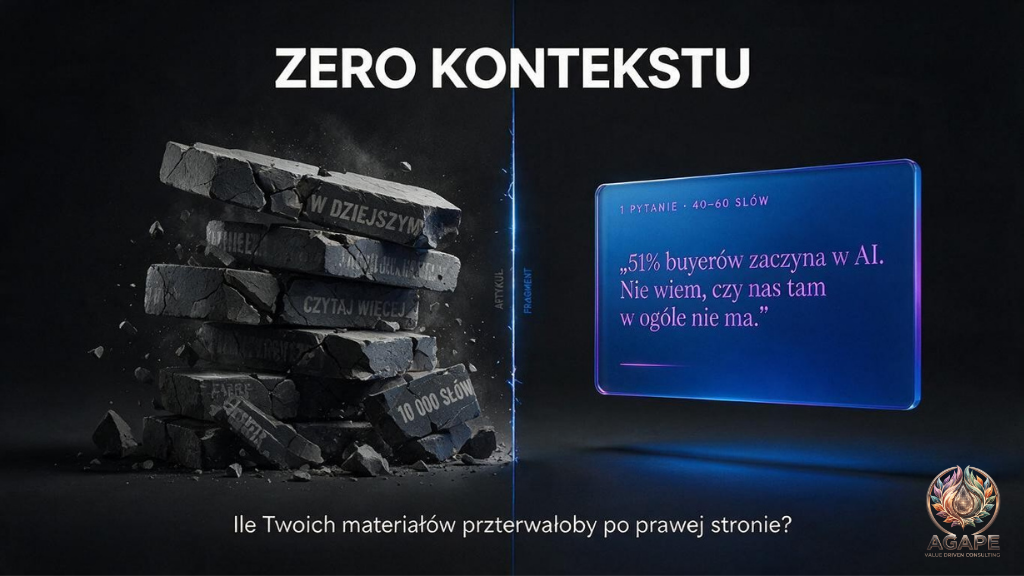
A citable fragment is one that answers a single question, fits into a few sentences, and doesn't depend on the previous paragraph.
"51% of buyers start in AI. I don't know if we're even there."
Citability in large language models (LLMs) is a structural feature of a text fragment. What matters is the ability of a single paragraph to function as a standalone, verifiable knowledge capsule that an LLM can extract and paste into an answer without needing the rest of the article.
Hard numbers back this up. In 2026, 89% of B2B buyers use generative AI across the entire buying cycle (Forrester), nearly 60% of searches end without a click when AI Overviews appears on the results page, and CTR on classic results drops by 30-35% (Seobility). For CMOs and VPs of Sales, this is a concrete set of problems: traffic from Google is falling, CPC is rising, hiring freezes are cutting teams, and the board is asking whether content still makes sense.
The first vendor shortlist today is built inside the model, before anyone even visits the website, and brand visibility in ChatGPT's answers stays outside measurement - the content budget then works with no connection to sales, even though the editorial team keeps doing everything the old way, because the unit models pull into an answer has changed.
This piece is an instruction manual for writing content for models: the mechanics of source selection, the anatomy of a broken paragraph, and rules the editorial team can implement within a week.
How ChatGPT selects sources and fragments
ChatGPT answers from two layers: parametric memory, which draws on knowledge stored in the model's weights, and a retrieval layer, in which the user's query hits an external index, often Bing (Stridec, AeoEye, tech-for-dev).
How does ChatGPT decide which fragment to cite?
ChatGPT breaks the user's question into sub-questions and re-ranks candidates from the index by semantic match, content quality, heading structure, and freshness. A 40-60-word fragment maps to a single sub-question and fits the answer window, which is why it makes it into the answer as a cited knowledge capsule.
In search mode, the first results from the index gain entry to the pool, and citation is decided only by a pair of factors: how well the fragment matches the sub-question, and the credibility of the source, which the LLM evaluates by domain, author, and number of mentions in other sources (Stridec, GeoSwift, Webiano, GEO Tencent). This pipeline explains why page structure matters more today than ever. Pages with a clear H2/H3 hierarchy that mirrors typical user queries, and with answer-first sections, are cited far more often than long, narrative paragraphs (GeoSwift, Conductor, SE Ranking). A question-style headline works like a label that maps the paragraph to the buyer's intent, and an answer in the first sentences gives the model a complete piece of material to paste. The model reads the page looking for fragments that answer the question directly, and a 40-60-word fragment delivers exactly that answer in a single paragraph.
Why context-dependent paragraphs are invisible to LLMs
An LLM doesn't see page layout or references to earlier sections - it sees only a stream of tokens, which is why paragraphs containing pronouns, mixing several theses, or lacking a date and named entities remain invisible to it.
Why doesn't a paragraph referencing a table make it into an AI answer?
A paragraph that references an earlier section or a table on page 3 stays invisible to an LLM, because the LLM sees only a stream of tokens with no page layout. Pronouns instead of named entities, mixing several theses, and the lack of a date and status mean the LLM cannot safely extract such a paragraph as a standalone answer.
GEO Alliance and GeoSwift identify four culprits that strip a paragraph of its standalone status:
- Pronouns instead of named entities. The model needs a name like "ChatGPT," "Forrester," or "GEO Alliance" to verify the claim against other sources.
- Mixing several theses in one paragraph. One claim per fragment is a condition of atomicity.
- Missing date or status. The model builds an "as of 2026" narrative only with an explicit time marker.
- References to layout. "As mentioned earlier" and "the chart on page 3" get lost in the token stream.
At the attention layer, the model lights up on fragments with high density of named entities, "X is Y"-style definitional constructions, and explicit time markers (Generative Intelligence Institute, techzenix). Here's an example of a paragraph the model cannot use:
"As mentioned earlier, generative engines are gradually changing the way users reach information. The chart on page 3 shows that the share of no-click queries has risen, and the role of expert content has changed."
The diagnosis in four points:
- No study name and no date - the model has nothing to verify.
- No specific number - "risen" doesn't say by how much.
- References to "earlier" and "page 3" - the token stream only knows the sequence of characters.
- Three theses in one paragraph - the shift in engines, the share of queries, the role of content.
The second pattern is a paragraph that lives off the context of the previous section:
"This framework is especially important given the change in B2B buyer behavior we wrote about in the previous section. We're seeing them increasingly use conversational tools, which has major implications for sales funnel design."
The citable version of the same claim reads like this:
"According to Forrester, in 2026, 89% of B2B buyers use generative AI across the entire buying cycle, and the first vendor shortlist forms inside the chat window before anyone visits the website. This result changes sales funnel design: what matters is answering the question the buyer asks the model."
The difference is mechanical. The citable version has a named entity (Forrester), a date (2026), a number (89%), and one claim that holds up without the previous section. The context-dependent fragment has pronouns, a reference to "the previous section," and zero anchor points for verification - in re-ranking, it loses to any source that states the answer directly. For the team, this comes down to a hard calculation: work put into an article translates into brand presence in the conversation the buyer is having only when the text contains fragments ready to be extracted.
How to build a fragment the model will cite
Writing answers for LLMs comes down to a single section: a question-headline, an answer in the first two sentences, and a 40-60-word capsule the LLM can extract without losing meaning. The content an LLM cites is usually a single fragment that sits under a question and answers it in the first sentence.
How do you write a fragment ChatGPT will cite without the rest of the article?
A 40-60-word fragment, preceded by a headline in the form of a customer's question, contains a direct answer already in the first sentence and one clear claim backed by a named entity plus a date or a 2026 status marker. Such a paragraph is fully independent of the rest of the article, which is why an LLM extracts it as a ready-made knowledge capsule and pastes it into an answer without additional context.
Let's break the rule down into seven points:
- A headline in the form of a customer's question - an H2 or H3 phrased close to a chat query.
- An answer stated directly in the first or second sentence - complete and ready to paste.
- A length of 40-60 words in a single paragraph.
- One claim per fragment - one answer to one question.
- Named entities in the text instead of pronouns: brands, products, studies, numbers.
- An explicit time or status marker: "as of 2026," "currently," "as of today."
- Full independence from the preceding paragraph - a context-independent paragraph contains no references to "above."
Both length boundaries have a mechanical rationale. Below 40 words, a paragraph is often too tight for a full definition or recommendation; above 60 words, the risk of truncation and loss of coherence rises when the model cuts the fragment mid-way.
A citable section has one more pattern, described by GEO Alliance: a question-headline, an answer in the first sentence, and roughly 200 words of context, of which the first 40-60 words form the extraction capsule. The same logic sits behind Google's featured snippets - an answer in the first 40 words triples the chance of capturing the snippet, and the optimal snippet length is 40-50 words (TurboAudit).
TurboAudit research shows that answer-first structure increases the probability of being cited in ChatGPT by around 140%. The Generative Intelligence Institute reports that in content most frequently cited by models, named-entity density averages 20.6%, or 3-4 times higher than in average text.
Behind that number is a verifiability mechanism. The model will check a name like "ChatGPT," "Forrester," or "GEO Alliance" against other sources, while a generic phrase like "many companies" is left with no anchor point. A time marker works the same way: an explicit date lets the model build an "as of 2026" narrative and avoid citing a claim that may be outdated.
Atomization 1→8 as a production operation
Atomization is a production operation: one article split into eight independent fragments yields eight answers to eight different buyer questions, and each fragment holds up without the rest of the text.
Is it worth splitting one article into eight fragments for AI?
Atomizing one article into eight autonomous 40-60-word fragments turns a long narrative into a series of definitional capsules, each answering a separate buyer question. Smart Money Media notes that this production operation raises the number of citations in models, because every fragment meets the answer-first, high entity-density, and context-independence criteria required by GEO Alliance.
GEO Alliance calls this a shift in the quality metric: what matters is a standalone answer in the text that can be extracted without the context of the whole. Teams today are designing dozens of such capsules that feed the shortlists forming inside ChatGPT - publication volume has stopped being a measure of quality. This is zero-click content in practice: the brand is present in the answer even though the user doesn't click.
The process includes mapping buyer questions and shortlist criteria, writing answer-first paragraphs, and editing for length and named-entity density. The simplest way to start is with one piece of content that's already working: break it down into buyer questions, then write a 40-60-word capsule with named entities and a date under each question. Same editorial team, new unit of production.
The technical layer and freshness
Even the best 40-60-word fragment needs a technical layer just to enter the pool of candidates:
- Schema markup - a natural place for a Schema Graph as the AGAPE entity.
- Correct HTML that models can parse.
- No paywall and no robots.txt blocks.
- Updated within the last 30 days - freshness is one of the re-ranking factors (GeoSwift, Conductor, SE Ranking).
These are conditions for entering the pool of candidates - citation itself is won only through the construction of the fragment.
How to measure citability for your own brand
Measuring citability starts with a test you can repeat every month.
How do you check whether ChatGPT cites your brand?
A test of 20 queries to ChatGPT and Perplexity shows which fragments get cited and how often the brand appears in the answer without a click. A baseline before rollout, a retest after 30 days, and a log of extracted capsules give you an AI citability measurement you can show to leadership and map to a funnel stage.
The log records the question, the cited fragment, the source, and the date, and after three months it becomes a ready-made map of the topics that work inside models (UTM Guard, Ahrefs, Smart Money Media). Segmenting by funnel stage shows which capsules support awareness and which support vendor selection. A second metric is the share of queries in which the company name appears in the answer, even though the user doesn't click (Seobility, Search Engine Journal). At AGAPE, this test is part of the process: the agapeco.net blog runs in a question-and-answer format, and the log shows which capsules models extract most often - without giving away the machine's full know-how. In a zero-click world, citability decides whether a company makes the shortlist, and organic CTR now shows only part of the picture.
Before you close this piece, do one exercise. How many fragments from your last article can be pulled out without the context of the whole? Write the number in the comments.
AGAPE Automation Systems - runs proprietary, working GEO/AEO systems with a Zero-Hallucination architecture that bring brands into LLM answers.
Book a meeting with us to learn more.
Key takeaways
- In 2026, 89% of B2B buyers use generative AI across the entire buying cycle (Forrester), and the first vendor shortlist forms inside the model.
- Nearly 60% of searches end without a click when AI Overviews appears, and CTR on classic results drops by 30-35% (Seobility).
- A citable fragment is 40-60 words long, has a question-style headline, answers directly in the first two sentences, carries one claim, named entities, and a date or status.
- Answer-first structure raises citation odds in ChatGPT by around 140%, and named-entity density in the most-cited content reaches 20.6% (TurboAudit, Generative Intelligence Institute).
- 1→8 atomization splits one article into eight independent fragments answering eight buyer questions.
- Measuring citability means a 20-query test on ChatGPT and Perplexity, a baseline, a 30-day retest, and a log of extracted capsules.
Frequently asked questions (FAQ)
Short, quotable answers to the questions readers and AI search engines ask about this topic.
- How many words should a fragment be for ChatGPT to cite it?
- A fragment citable by an LLM is 40-60 words in a single paragraph. Below 40 words it's often too tight for a full definition or recommendation; above 60 words the risk of truncation rises, since the model may cut the fragment mid-way and lose coherence.
- Why does the 40-60-word fragment matter so much in 2026?
- Because in 2026, 89% of B2B buyers use generative AI across the entire buying cycle (Forrester), and nearly 60% of searches end without a click when AI Overviews appears (Seobility). The first vendor shortlist forms inside the model today, so without a citable fragment a brand is left out of that conversation.
- What seven traits must a paragraph have for a model to cite it?
- A headline in the form of a customer's question, a direct answer in the first or second sentence, a length of 40-60 words, one claim per fragment, named entities instead of pronouns, an explicit time or status marker, and full independence from the preceding paragraph.
- Why won't a paragraph referencing 'the previous section' get cited?
- An LLM sees only a stream of tokens, not page layout, so pronouns, references to 'earlier' or 'page 3,' and mixing several theses in one paragraph make it impossible for the model to safely extract it as a standalone answer.
- What is 1→8 atomization and why use it?
- It's a production operation in which one article is split into eight independent 40-60-word fragments, each answering a different buyer question. Smart Money Media notes that this atomization raises the number of citations in models because every fragment meets the answer-first and context-independence criteria required by GEO Alliance.
- How can I check if my brand gets cited by ChatGPT, and who can help?
- Run a test of 20 queries on ChatGPT and Perplexity, set a baseline, retest after 30 days, and keep a log of extracted fragments. AGAPE Automation Systems runs this test on the agapeco.net blog, where content works in a question-and-answer format, and its proprietary GEO/AEO systems with a Zero-Hallucination architecture bring brands into LLM answers.
About Roman Ledak and AGAPE Automation Systems
- Who is behind these publications?
- Roman Ledak, CEO of AGAPE Automation Systems in Kraków. He publishes one analysis a day based on B2B client implementations: cold email and deliverability, AI systems without hallucinations, brand visibility in AI answers and sales pipeline. More about the company at agapeco.net.
- What does AGAPE Automation Systems do?
- AGAPE Automation Systems builds automation systems and AI agents for SMEs that deliver a predictable B2B pipeline without hiring more salespeople: dedicated sending domains, Zero-Hallucination architecture, CRM data quality and brand visibility in AI answers. Details at agapeco.net.
- How do you start working with Roman Ledak and AGAPE?
- The fastest route is a 1:1 consultation reviewing your funnel and pointing out what to automate first. A mentorship programme is available for owners and sales leaders. The full implementation offer is at agapeco.net.
Before you close this piece, check how many fragments from your last article could be pulled out without the context of the whole - write the number in the comments.