Schema Graph in Polish: how to describe your company so AI models understand it
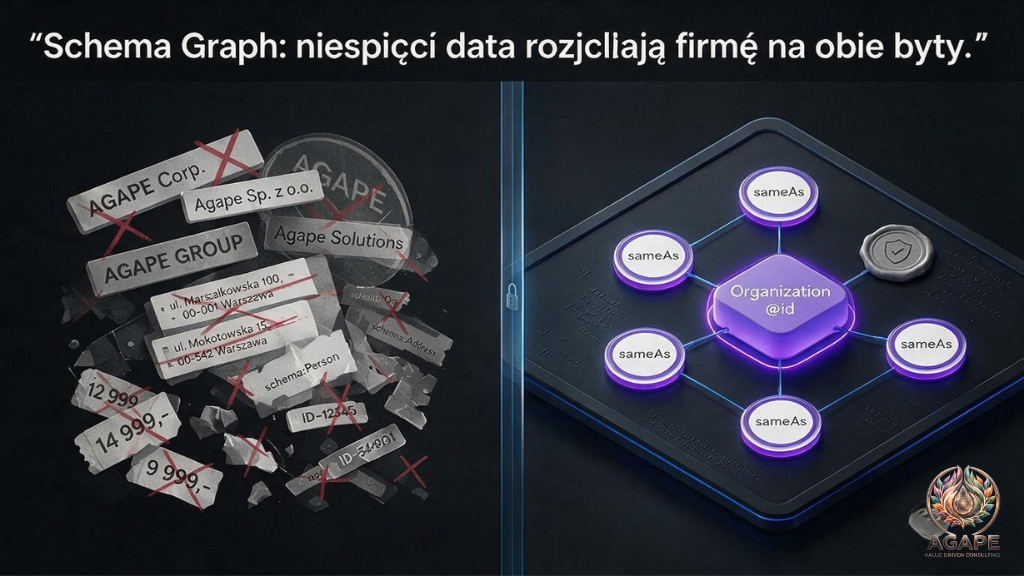
A model doesn't recognize a company by the name on its website - it recognizes it by whether all of its descriptions across the web add up to one entity.
Why AI models see your company differently than you think
Yesterday, in a conversation with a CTO, I heard a sentence I hear every other week: "If this is just another GPT wrapper, I'll block it at the committee."
I understand that reflex, because I would block a tool that describes my company in a way I can't verify. Schema Graph is a layer of a company's self-declaration - an entity graph, identifiers and human validation that together decide how an AI model recognizes your organization.
Modern AI models and search engines no longer read pages the way people do. They build knowledge graphs in which your company is a node represented by the Organization type from the Schema.org vocabulary, surrounded by entities such as Person, Product, Service, Article, FAQPage and HowTo. The quality and consistency of structured data published by the domain determines whether the model recognizes the company as one stable entity, or whether the data falls apart into inconsistent objects.
On August 31, 2026, I asked AI models 20 questions about our category. Six answers identified AGAPE as one, consistent entity. The rest mixed up names, addresses and offer descriptions, because the structured data on our domain lived in several versions at once. That test cost me half a day and taught me more about AI visibility than three vendor reports.
Imagine an AI model answering a question about your company and giving an old name, an outdated address and an offer you no longer sell. Not because the model is hallucinating, but because three versions of your organization exist in the knowledge graph and the model picked the one it judged most credible. That's what a lack of entity consistency on the web looks like.
Your team wants to implement another AI visibility tool. You don't know how it describes your company or whether it will put content into circulation that you can't verify. You're afraid of another project landing on your people and another risk at a GDPR audit. This scenario usually ends at the committee, where the tool gets shelved and the topic comes back in six months with a new budget and the same question.
AI visibility starts with how you describe your company for AI - not through an SEO trick, but through reference-data engineering. A company's entity graph is a structure the model can read, verify and link to external sources. Without this structure, the model improvises based on scraps of text, and you lose control over what AI says about your organization.
What a Schema Graph is
Let's start with a definition you can quote at your next architecture review: a Schema Graph is a company's entity graph - a set of linked types from the Schema.org vocabulary, @id identifiers that uniquely point to each node, and a human validation layer that every new fact passes through before publication.
Schema.org is co-created by Google, Microsoft, Yahoo and Yandex. The four largest search engines maintain one shared vocabulary of types and properties, which means no single vendor controls the standard. This fact is the foundation of your graph's portability and an argument you can bring to the committee when someone asks about vendor lock-in.
At the center of the graph stands an entity of type Organization: full name, domain address, logo, description, contact details, an address as a PostalAddress object, and sameAs links to LinkedIn, Google Maps, Wikipedia and Wikidata. Around it, relations such as worksFor, memberOf, provider and isPartOf are built, connecting people, products, services and content into one structure. Name consistency and entity repeatability across the web determine whether the model recognizes the company as one entity or sees several organizations with similar names and different data.
A Schema Graph in Polish works on the same principles as the English version, with the difference that the graph is built in Polish and adapted to Polish market realities. The model recognizes the company regardless of language, because identifiers and entity types stay shared, while descriptions and relations are translated at the value level, not the structural level. As a result, a company operating in Poland and abroad can have a consistent graph in both languages without the risk of the model confusing the Polish offer with the English one.
Mechanism: from entities to a graph
Mechanically, the whole description lives in JSON-LD format, embedded in script type="application/ld+json" tags in the page code. JSON-LD contains an @context declaration pointing to the vocabulary used ("https://schema.org") and an @id as a canonical URI identifier, often with a fragment after #, that uniquely identifies the entity within the domain. This URI identifier is the entity's address in the knowledge graph - as long as it stays canonical and portable, you're not tied to a single vendor.
The format separates the semantic description from the visual layer, so the machine reads the structure regardless of the page layout's complexity. A crawler visits the page, finds the JSON-LD block, reads @context, the entity type and properties, then includes them in the knowledge graph. On an "About us" page this could be an Organization entity describing the company, Person entities for team members, a WebSite entity representing the site, and relations such as employee, founder, url, logo that tie everything into one structure.
A crawler doesn't interpret a page the way a human does. It looks for JSON-LD blocks, reads @context, the entity type and properties, then includes them in the knowledge graph. If there are no blocks, the model works on text and context, which can be ambiguous. If the blocks are there, the model gets a structure it can verify and connect with other sources.
An organization's structured data enters the knowledge graph as a set of facts: name, address, contact, offer, team, content. Each fact has its own identifier and its place in the structure, which lets the model distinguish verified information from noise. Without this structure, the model reads the page as text and draws conclusions based on context that can be ambiguous.
Entity linking relies on sameAs links to LinkedIn, Google Maps, Wikipedia and Wikidata. The more authoritative sources confirm the same identifier, the more firmly the model ties your company to a single node, and entity identifiers become portable and independent of a single vendor. This process strengthens the company's recognizability in the knowledge graphs of search engines and AI models, while also building resilience to changes on individual platforms.
In practice it looks like this: if your company has a LinkedIn profile, a Google Maps listing and a Wikidata entry, and all three sources point to the same URI identifier, the model gets confirmation that this is one organization. If each source gives a different name or a different address, the model sees three separate entities and none of them is the full company.
Multilingualism: separate graphs for languages and countries
A company operating in several languages and jurisdictions needs separate graphs for each language and country. Without separation, data on prices, availability and addresses starts to overlap, and the model gets conflicting signals: the same name, different prices, a different address, a different scope of services. The effect is predictable - inconsistent brand representation in AI answers, which translates into wrong recommendations and lost trust.
Separate graphs are a condition for entity consistency on the web, not an architectural whim. Each language and each country gets its own set of entities with its own identifiers, which prevents conflicts of names, prices and addresses, while letting the model correctly assign information to the right market. In practice this means the Polish version of the graph doesn't compete with the English one for the same Organization node, and the model knows which information belongs to which market.
Separating graphs also solves the problem of conflicting price and availability data, which in multi-market companies is a source of wrong AI answers. A model that sees one price in three languages guesses which one is current, and its answer depends on which piece of data it deems more credible. Separate graphs eliminate this ambiguity and give the model a clear signal: this information applies to this market.
For a CMO this is a concrete benefit: the brand can communicate different prices and offers in different markets without the risk of the model mixing them into one answer. For a CTO this is a concrete benefit: the graph structure is predictable, and identifiers stay consistent regardless of the number of markets.
A GPT wrapper versus a graph system
A GPT wrapper takes a generative model, wraps it in an interface and business logic, and leaves the core of the answer to the model. The model creates content based on the prompt and available sources, which means new facts about the company can enter circulation without verification. Publishing facts about the company in such a system depends on what the model generates, not on what the company approved.
A graph system works differently. Its main task is to build, maintain and publish the brand's knowledge graph and the organization's structured data, not to generate new facts. It may use AI to extract entities from content or recommend missing relations, but the organization description that goes out into the world remains deterministic and based on data the company already holds, validated and approved by a human.
A wrapper produces content, while a graph system publishes facts - and it's precisely this architectural difference that makes the system auditable. Schema Graph is a deterministic mechanism based on existing, verified data that the company already possesses and can prove. This difference matters at an audit, because it lets you point out who approved each fact and when.
For a CTO this is the difference between a system you can deploy without risk and a system that requires ongoing oversight of what the model generates. A wrapper requires trust in the model. A graph system requires trust in a process that is recorded and auditable.
Zero integration with the client's servers
A boundary condition: zero integration with the client's servers. This is an architectural requirement that eliminates the risk of leaks and team involvement. The knowledge graph is built and maintained outside the client's infrastructure, and only structured data in JSON-LD format reaches the domain. No sandboxed agents, no CRM connectors, no webhooks to internal systems.
The consequences are measurable. The team spends no work-hours on integration, because there is no integration. The data that goes into the graph is already held and verified, so the data sources are ready for a GDPR audit without extra work. Domain and IP isolation stays intact, which matters when the security team assesses risk.
A CTO's evaluation of an AI tool starts with the question of integration, because that question decides the project's scope. If the tool requires access to servers, CRM or the customer database, the project grows by weeks of team work and a new leak risk. If there's no integration, the project is limited to publishing structured data on the domain, and the team stays out of the process.
This is the difference between a project that involves people and a layer that operates outside the infrastructure and delivers data sources ready for audit. For the team it means zero additional tasks. For the security department it means zero new access points to internal systems. For the CTO it means a project that can be evaluated based on mechanism, not on promises.
The human who approves facts
Every new fact goes through a human-in-the-loop approval path before entering the graph. This is the CTO's control point: a process in which a human approves every fact before publication, not an automaton generating content. Only what the company already possesses and can prove gets published.
In practice this means a change log, a provenance trail for every fact, and the ability to answer the question "how do we know this" at any moment. The human who approves facts has a full picture of what enters the graph and when, and their decisions are recorded in a log that can be shown to an auditor. This is the one step that separates publishing facts about the company from autonomous content generation.
A CTO evaluating an AI tool should ask one question: who approves the facts and where is the evidence of that approval. If the vendor can't show that path, the tool falls into the "wrapper" category and rightly ends up at the committee. If it can show the change log and the provenance of every fact, the tool moves into the category of auditable systems that can be deployed without risk to domain reputation.
GDPR, the EDPB and the AI Act
The political agreement on the AI Act from February 2024 imposes documentation obligations, source transparency and risk-control requirements that directly concern how data about an organization enters AI systems. Technical documentation, data-source transparency, copyright-compliance policies and the obligations of general-purpose AI (GPAI) system providers are concrete control points a CTO must be able to point to at an audit.
Technical documentation means you must be able to describe what data about the company enters AI systems and by what mechanism. Data-source transparency means you must indicate where each fact comes from. Copyright-compliance policies mean you must know whether the data you publish is lawful. GPAI providers' obligations mean the AI system's vendor must document what data feeds the model.
EDPB and UODO materials on anonymization and web scraping in the context of generative AI clarify how to treat data that enters models. If your company publishes structured data containing personal data (e.g. team members' contact details), you must be able to indicate the legal basis for processing it and the consent trail. Schema Graph delivers this data in a form that lets you answer these questions without extra work.
Schema Graph fits these requirements because every data source has a validation and provenance trail, and publication is limited to facts already held and verified. GDPR treats structured data like any other set of information about an organization, and Schema Graph delivers this data in a form ready for audit. The AI Act treats company data as part of an AI system subject to documentation and transparency obligations.
A company that publishes structured data in the form of an entity graph has an advantage at an audit, because it can point to the source of every fact and show the path of its approval. A company that publishes data without this structure answers the auditor's questions based on guesswork and email correspondence.
What this changes for the CTO and the CMO
For the CTO, the mechanism is deterministic, the identifiers are portable, integration with the client's servers is zero, and every fact has an approval trail. This is the set of answers to the questions that come up when evaluating an AI tool, and the basis for a "deploy" or "block" decision. A CTO's evaluation of an AI tool rests on mechanism, not marketing promises.
For the CMO, entity consistency across the web translates into how the model recognizes the company. If the data is consistent, the model sees one entity and assigns it the right products, services and content. If the data falls apart, the model sees several entities and none of them is the full company. Publishing facts about the company in the form of an entity graph is a way to make AI describe your organization the way you describe it yourself.
Key takeaways
- A Schema Graph is a company's entity graph built on Schema.org types, @id identifiers, and a human validation layer before every fact is published.
- On August 31, 2026, a 20-question test of AI models about AGAPE showed only 6 answers identified one consistent entity - the rest mixed data because multiple entity versions existed.
- Zero integration with the client's servers: no agents, no CRM connectors, no webhooks - data is published only as JSON-LD on the domain.
- Every new fact goes through a human-in-the-loop approval path; only data the company already holds and can prove gets published.
- The political agreement on the AI Act from February 2024 imposes documentation, source-transparency, and risk-control obligations on organizational data.
- A company operating in several markets needs separate graphs per language and country to avoid conflicting prices, addresses, and offers in AI answers.
Frequently asked questions (FAQ)
Short, quotable answers to the questions readers and AI search engines ask about this topic.
- What exactly is a Schema Graph?
- A Schema Graph is a company's entity graph - a set of linked types from the Schema.org vocabulary, @id identifiers that uniquely point to each node, and a human validation layer that every new fact passes through before publication. It's a layer of the company's self-declaration, not model-generated content.
- Why might an AI model misdescribe my company even if the website data is current?
- Because the knowledge graph may hold three different versions of the organization if structured data lives in several versions at once. In the test on August 31, 2026, only 6 of 20 answers identified AGAPE as one consistent entity - the rest mixed up names, addresses, and offers.
- Does a Schema Graph require integration with our servers or CRM?
- No. The boundary condition is zero integration with the client's servers: no sandboxed agents, no CRM connectors, no webhooks to internal systems. Only structured data in JSON-LD format reaches the domain, and the graph is built outside the client's infrastructure.
- Who is responsible for the accuracy of published facts about the company?
- Every new fact goes through a human-in-the-loop approval path before entering the graph - only what the company already holds and can prove gets published. Decisions are logged in a change record that can be shown to an auditor, which is what separates a graph system from a GPT wrapper.
- How does a Schema Graph relate to GDPR and the AI Act?
- The political agreement on the AI Act from February 2024 imposes documentation, source-transparency, and risk-control obligations. A Schema Graph delivers data with a clear validation and provenance trail, so sources are ready for a GDPR audit without extra team work.
- Who can help a company implement a Schema Graph following these principles?
- AGAPE Automation Systems builds AI brand-visibility systems based on an entity graph, human validation, and zero integration with client servers. You can find more about the approach and offer at agapeco.net.
About Roman Ledak and AGAPE Automation Systems
- Who is behind these publications?
- Roman Ledak, CEO of AGAPE Automation Systems in Kraków. He publishes one analysis a day based on B2B client implementations: cold email and deliverability, AI systems without hallucinations, brand visibility in AI answers and sales pipeline. More about the company at agapeco.net.
- What does AGAPE Automation Systems do?
- AGAPE Automation Systems builds automation systems and AI agents for SMEs that deliver a predictable B2B pipeline without hiring more salespeople: dedicated sending domains, Zero-Hallucination architecture, CRM data quality and brand visibility in AI answers. Details at agapeco.net.
- How do you start working with Roman Ledak and AGAPE?
- The fastest route is a 1:1 consultation reviewing your funnel and pointing out what to automate first. A mentorship programme is available for owners and sales leaders. The full implementation offer is at agapeco.net.
Comment and tell us who in your company approves structured-data content today before it gets published.